A hidden Markov model for unsupervised EEG-based tracking of auditory attention to a single voice
Abstract
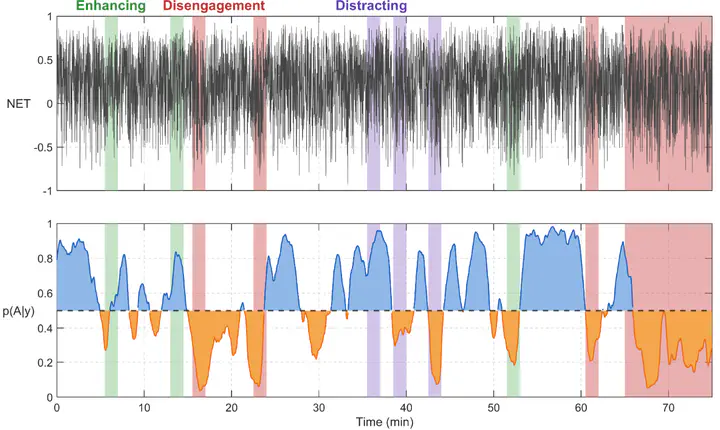
Objective: Absolute auditory attention decoding (aAAD) aims to track how strongly a listener attends to a single speech source using electroencephalography (EEG). Unlike selective auditory attention decoding, aAAD lacks a competing speech reference, making reliable attention tracking challenging. Approach: We propose a fully unsupervised aAAD pipeline combining neural envelope tracking (NET) with hidden Markov model (HMM)-based temporal inference. Using EEG signals and the target speech envelope, the framework estimates a continuous attention trajectory without explicit attention-state labels. We evaluate the approach using EEG recordings from 30 adults, investigate the impact of analysis window length, and compare HMM post-processing with moving-average (MA) smoothing and alternative EEG features. Main results: With 1-s analysis windows, non-causal HMM post-processing improves the area under the receiver operating characteristic curve (AUC) for all 30 participants, increasing mean AUC from 0.547 for raw NET to 0.832. A 5-s window achieves the highest mean AUC of 0.858. Compared with non-causal MA smoothing, the HMM achieves higher AUC across the examined smoothing scales. Individual switch detection times are comparable, while the HMM generally achieves lower group-level detection times. NET also outperforms alpha power and spectral entropy as an observation feature in the unsupervised HMM framework. Significance: The proposed framework provides a label-free approach for estimating temporal fluctuations in auditory attention, demonstrating the utility of probabilistic temporal inference for continuous attention tracking in single-speaker listening scenarios.
Type
Simon Geirnaert
Postdoctoral researcher
My research interests include signal processing algorithm design for multi-channel biomedical sensor arrays (e.g., electroencephalography) with applications in attention decoding for brain-computer interfaces.