Modeling and Interpreting Correlations, Null Distributions and Significance Levels in Neural Tracking of Natural Stimuli
Abstract
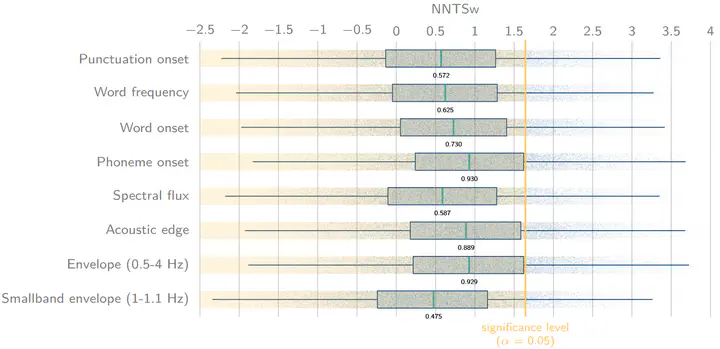
Neural tracking - the time-locking of neural responses to continuous stimuli such as speech, music, and video - is widely used to study how the brain processes natural input. Tracking strength is typically quantified as the correlation between the recorded neural response and the stimulus, decoded and/or encoded through data-driven models, and this correlation is routinely used to compare stimulus features, models, or settings. However, its magnitude depends not only on how strongly the brain tracks the stimulus, but also on the statistical properties of the signals being correlated. For example, a smallband speech envelope carrying almost no information about speech content yields among the highest correlations, simply because it is easier to reconstruct. Meaningful interpretation therefore requires comparing each correlation to its null distribution: the correlations expected without any stimulus-response relationship. We show that the randomization procedures commonly used to construct this null distribution are not interchangeable: each implicitly encodes a different null hypothesis, and we motivate stimulus-response misalignment as the most practical and appropriate choice. Because reliable null distributions require many permutations, we introduce a semi-parametric model using the normal distribution after the Fisher transform that yields accurate significance levels from only 3-5 min of data and predicts them across analysis window lengths. Building on this, we propose the null-normalized tracking score (NNTS), an interpretable measure placing features and models on a common scale, which relates directly to the widely used match-mismatch accuracy. Applied to EEG from 121 participants listening to continuous speech, represented across eight acoustic and linguistic features, the framework reverses conclusions drawn from raw correlations, providing an efficient and principled methodology for interpreting neural tracking correlations and comparing features and models.
Type

Simon Geirnaert
Postdoctoral researcher
My research interests include signal processing algorithm design for multi-channel biomedical sensor arrays (e.g., electroencephalography) with applications in attention decoding for brain-computer interfaces.