Abstract
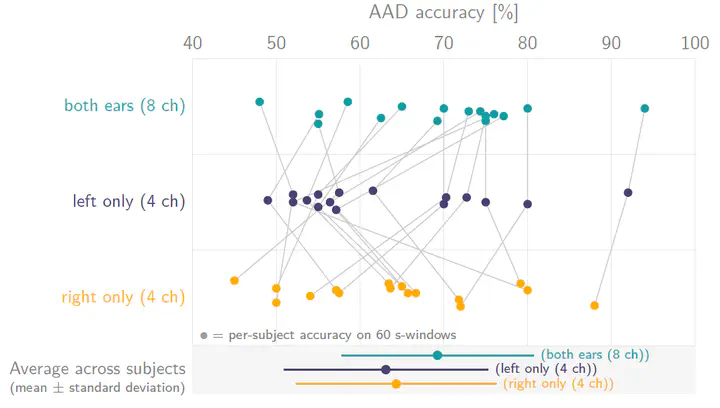
Objective. Selective auditory attention decoding (sAAD) enables neuro-steered hearing devices through identification of the attended speaker in a multi-speaker environment, using neural activity recorded with electroencephalography (EEG). Despite substantial progress in decoding algorithms, practical deployment remains constrained by a lack of wearable, unobtrusive, and fully wireless EEG acquisition solutions. Therefore, this work aims to evaluate whether reliable sAAD can be achieved under realistic hardware constraints imposed by miniaturized, galvanically isolated EEG sensor nodes. Approach. We investigate sAAD using a wireless EEG sensor network (WESN) setup consisting of two synchronized, compact around-ear EEG sensor nodes worn bilaterally. The nodes are fully galvanically isolated (i.e., there is no wire between them), each providing four local EEG channels derived from five pre-gelled electrodes, including a local reference. Sample-wise wireless synchronization of data from both nodes enables joint processing as an eight-channel EEG. Using a newly recorded dataset acquired with this setup, we evaluate correlation-based stimulus decoding and assess the effects of miniaturization and galvanic isolation between WESN nodes. Main results. Using a standard correlation-based stimulus decoding approach, an average sAAD accuracy of 69.24% is achieved on 60s decision windows, comparable to wired around-ear EEG systems that measure long-distance scalp potentials. Hidden Markov model-based post-processing further improves performance to a steady-state accuracy of 77.17% with an average attention switch detection time of 32.79s. Combining sensor nodes at both ears outperforms single-ear configurations, primarily through increased robustness via redundancy rather than by exploiting complementary spatial information. Finally, we show that a fixed bipolar configuration using four electrodes per ear, yielding three channels, suffices to maintain performance. Significance. These results demonstrate the practical feasibility of sAAD using a fully wireless, galvanically isolated around-ear WESN. By establishing a realistic performance benchmark under practical hardware constrains, this work represents a considerate step towards deployable neuro-steered hearing devices.
Type

Simon Geirnaert
Postdoctoral researcher
My research interests include signal processing algorithm design for multi-channel biomedical sensor arrays (e.g., electroencephalography) with applications in attention decoding for brain-computer interfaces.