Why Performance Metrics Overpromise in Auditory Attention Decoding: an Information-Theoretic Reappraisal
Abstract
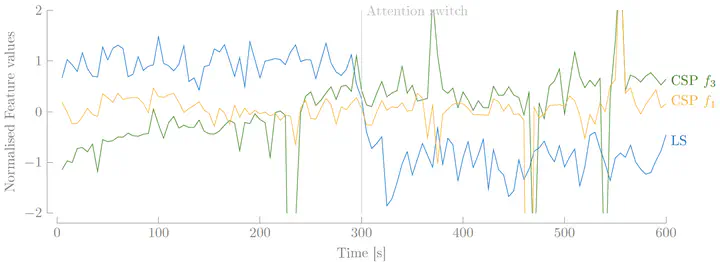
Auditory attention decoding (AAD) algorithms are predominantly evaluated in a steady state where a listener continuously attends to the same speaker, using metrics such as accuracy and information transfer rate. However, such metrics fail to account for the (in-)dependence of an AAD prediction with respect to previous predictions. In this paper, we argue that failing to take this dependence into account in the algorithm evaluation can lead to severe misrepresentations of the true performance of an AAD algorithm. We therefore introduce the relative Incremental Mutual Information (rIMI); the rate at which a new prediction removes the remaining uncertainty about the identity of the attended speaker. This allows us to track how much new, useful information a prediction actually generates on top of the nformation already obtained from previous predictions. By investigating the rIMI and the behaviour of AAD models around attention switches, we demonstrate that recent direct-classification AAD algorithms are not superior to traditional AAD algorithms based on stimulus reconstruction, despite what accuracy alone may suggest. We also demonstrate how these direct-classification AAD predictions are severely influenced by irrelevant feature drifts, which artificially inflates accuracies by leaking information across windows, and even across trials.
Type

Simon Geirnaert
Postdoctoral researcher
My research interests include signal processing algorithm design for multi-channel biomedical sensor arrays (e.g., electroencephalography) with applications in attention decoding for brain-computer interfaces.